Big Auto One / Flexibility
Built to be re-fitted
Requirements move. A sensor goes out of production, a customer already owns a radio fleet, a payload changes between one deployment and the next, and a vehicle bought for one job is asked to do another. The architecture treats all of that as normal.
The principle
Interfaces,
not parts
Every component that could reasonably be swapped sits behind a stated interface: what it must deliver, at what rate, with what accuracy, and how it reports that it is unwell. The autonomy is written against those statements.
The consequence is the thing that matters commercially. Changing what is bolted to the vehicle is an integration and a qualification exercise. It is not a rewrite of the software that keeps it safe, and it does not re-open the behavior that was already proven.
| Fitted per mission | Constant across them |
|---|---|
| Sensing package | The terrain model, obstacle classes and update rates the autonomy consumes |
| Mission payload | The power, data and command interface it rides on, and the limits attached to it |
| Radios and network | The session, the authority model and the degradation ladder above it |
| Operating limits | The safety core that enforces them and the signature it checks first |
| Ground fit-out | Control authority, handover and the backup center's ability to take over |
Where it flexes
Six places we expect
you to change it
Sensing
The autonomy's requirement is expressed as coverage, range, rate and classification confidence — not as a product. A mission that runs at night, into obscurants, or at higher speed changes the requirement, and the requirement changes the fit.
Range is a speed limit, and the vehicle knows it. The speed ceiling is derived from how far ahead the vehicle can currently classify the ground and what is standing on it, so a lighter sensing fit does not become an unsafe vehicle. It becomes a slower one, and the operator is told why.
Payloads
Mission equipment mounts on documented power, data and command interfaces. A payload declares what it is and what it needs; the vehicle attaches operating limits to it — mass, center of gravity, slope, speed — and enforces them from that point on.
The vehicle also measures what it is actually carrying and compares that against what the record says it is carrying. When those disagree, the crew hears it from the vehicle rather than from the recovery afterwards.
Radios and networks
No link is privileged and no topology is assumed. The gateway carries an authenticated session over whatever paths are available and moves between them without dropping it — direct, through another vehicle acting as a relay, or over a long-haul backhaul when the mesh cannot reach.
Where emissions matter, the vehicle can be held quiet and still be under authorization, reporting on a schedule the crew set rather than continuously.
The picture you already run
A unit does not adopt a new common operating picture because it bought a vehicle. Ours publishes into the one already in use and accepts tasking and hazard reports back out of it.
That loop is closed, not cosmetic. A route closure somebody else posted arrives as a keep-out inside a re-issued authorization, and the vehicle's route bends around it without an operator retyping a coordinate.
Where the software runs
The same stack runs three ways: as a set of nodes on the standard robotics middleware an integrator's team already knows, as a lean process on the vehicle where that overhead is not wanted, and entirely in simulation with no hardware at all.
All three run the same code. Simulation is not a separate model of the vehicle that has to be kept honest — it is the vehicle's own software with its edges simulated.
Limits and roles
Every threshold that shapes behavior — speed ceilings, slope limits, standoffs, timeouts, loss-of-link actions, geofence margins — is a versioned configuration value. The set the safety core enforces is signed, and it verifies that signature before it will permit motion.
Re-roling a vehicle is therefore a reviewable change to a file with a signature and a version on it, which is an auditable act rather than a new build.
One hull
The deck is the
whole argument
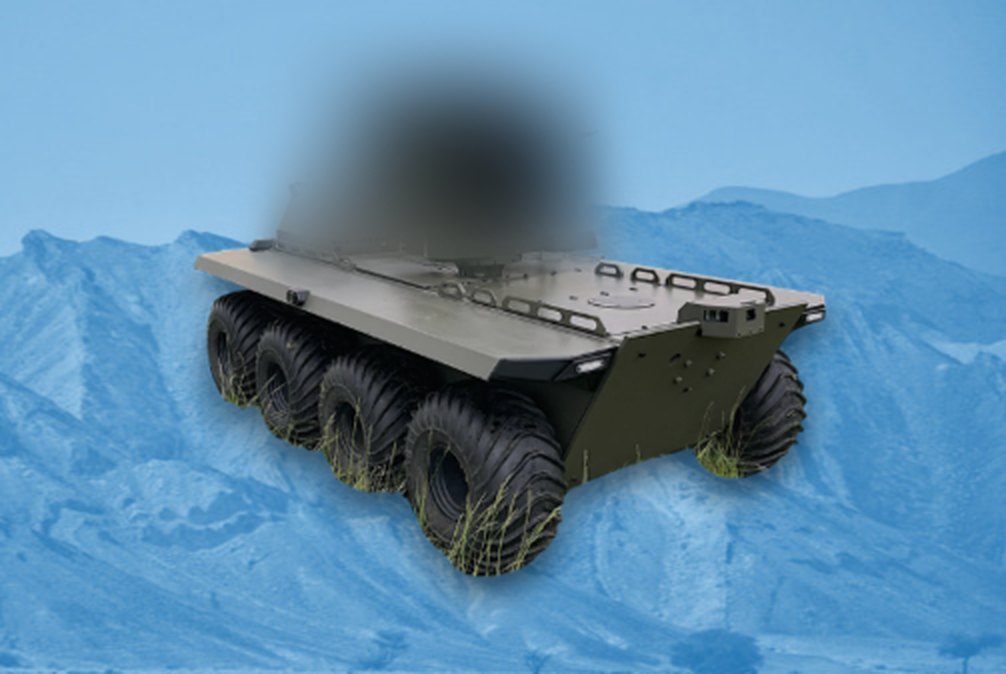
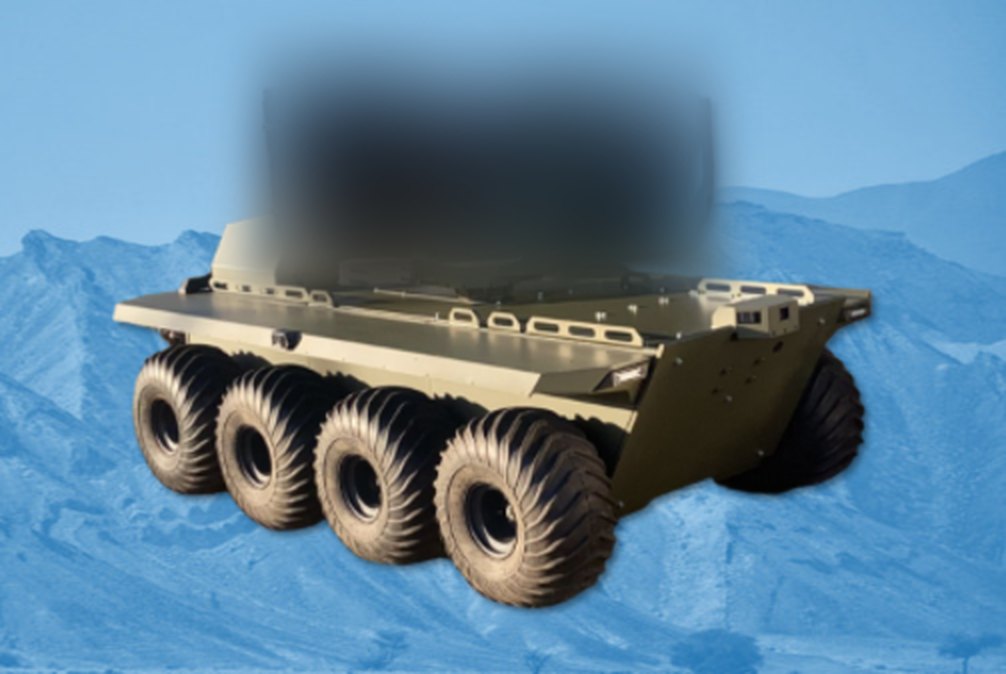
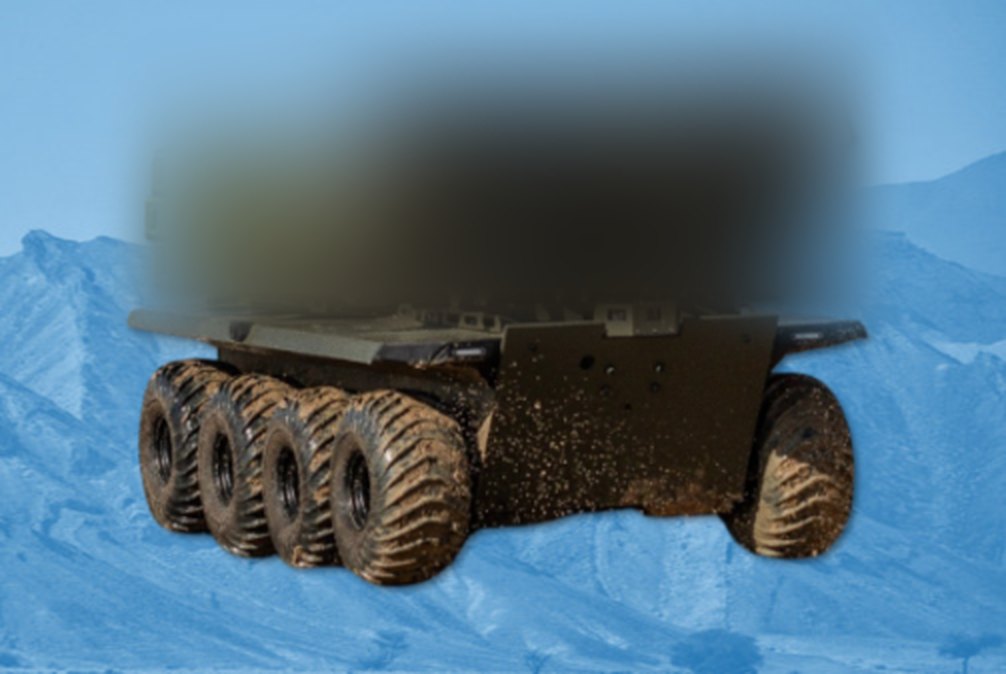
Spectre is a flat, load-bearing deck over a skid-steered 8x8 that can pivot in place, built by Jackson Duma Defense Group — a platform already tested by multiple governments and entities, and ready for manufacturing today. What goes on that deck is a fitting decision with limits attached to it — and our software is what holds the vehicle to those limits, whatever is bolted up there.
Beyond one vehicle
The stack is not
married to the hull
The command, safety and autonomy architecture is written for a class of vehicle rather than for a single chassis.
Steering geometry
The baseline is a skid-steered platform that can pivot in place, and the motion interfaces carry a reserved path for a conventionally steered variant. The layers above do not know the difference.
Size class
Mass, power, gradient and speed are parameters of the plant and of the envelope, not assumptions in the planner. A larger or smaller platform is a new configuration and a new qualification, not a new autonomy.
Mixed fleets
Vehicles on one mesh do not have to be identical. Each carries its own limits and declares its own capability, and the crew commands them from the same station.
Ground footprint
A command center is a fit-out, from a full dual-center installation down to a single rugged station. The authority model is the same at every size.
Fit it to your problem
Tell us what has to change
If you already know the sensing, the radios or the picture you are committed to, that is the most useful thing you can bring to a first conversation.