Big Auto One

Big Auto One  /  Missions

The jobs it is built for

Every mission below exists as a rehearsal: real elevation and imagery of real ground, the production vehicle software, the production safety core, the production ground software, and a network that is allowed to misbehave. We would rather learn what the terrain does to the plan before the day than during it.

Mission set

Four kinds of day

Sustainment

Moving what people should not have to

Resupply and repositioning over ground where the value of a crewed vehicle is mostly the crew inside it. Load it, authorize a route, and keep the people at the other end of a radio.

  • Long routes with the crew out of line of sight
  • Hazards reported by others become keep-outs en route
  • The vehicle weighs its own load and checks it against the manifest
  • Several vehicles on one mesh, dispatched as a group or worked separately
Overwatch

Watching a route, a site, or each other

A vehicle held on useful ground, or moving slowly across it, keeping a picture the crew can work from — and cross-checking that picture against a second point of view.

  • Static or roving observation under a single authorization
  • A sensor on a relay watching the vehicle itself
  • Two views of the same ground compared, disagreement surfaced
  • Quiet operation: reporting on a schedule rather than continuously
Disaster response

Going in when the ground has changed

Flood, fire and storm damage all produce the same problem: the map is hours out of date and the route is not knowable in advance. The vehicle decides from the contour it measures, and reports back what it found.

  • Water depth against real elevation decides which streets are still routes
  • Heat is felt in the drivetrain, and the vehicle slows itself accordingly
  • Sweeping for people with a standoff rather than a stop
  • One road in, no reliable link, and a crew who must not be on it
Urban

Streets, and everything in them

Built ground is the hardest case for both halves of the problem: positioning is worst exactly where the obstacles move, and the link is worst exactly where the walls are.

  • Positioning that does not depend on a clear view of the sky
  • Roads preferred over the ground beside them, without hand-drawn routes
  • People and vehicles classified, not merely detected
  • Hazards posted by others arriving mid-route
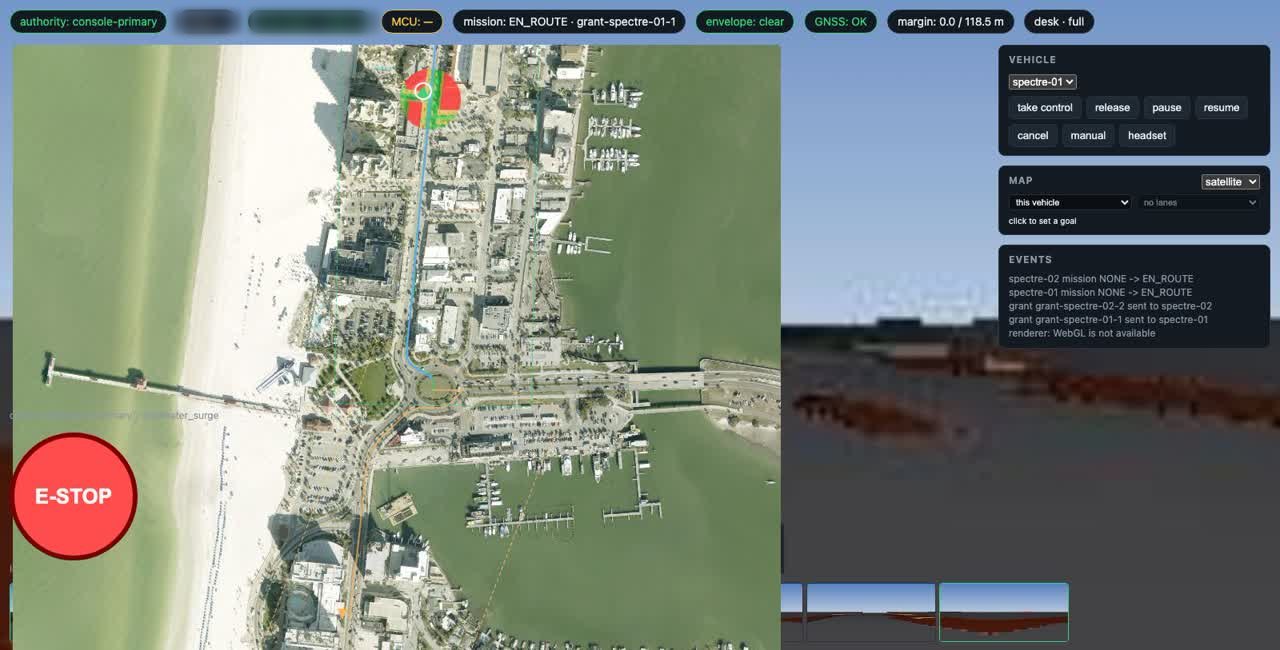
The console over a flooded coastal town, the map showing which streets are still routes
Water decides the route. Surge depth against surveyed elevation, on a barrier island with one way off it. Which streets are still passable falls out of the contour rather than out of a line drawn by hand. Regions blurred: compute supplier, link and radio detail
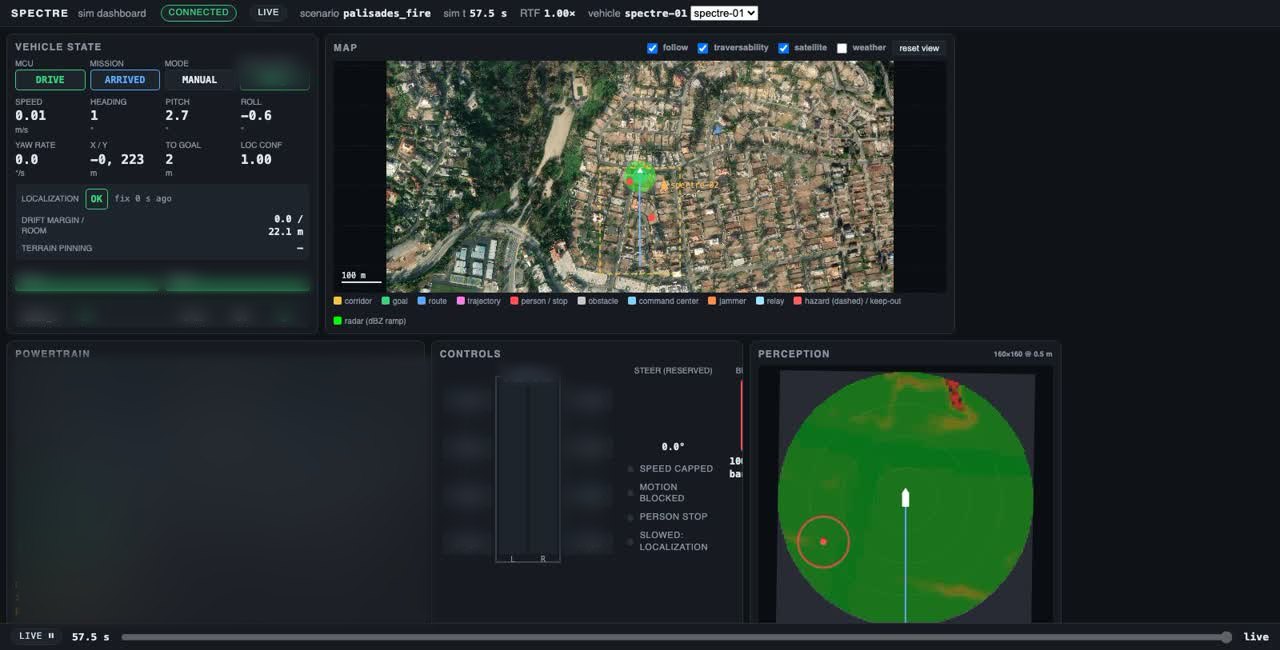
The dashboard on a canyon road during a wildfire rehearsal, with the vehicle derating
Heat arrives through the drivetrain. There is no fire sensor on this vehicle and it does not need one: hot air means the cooling stops rejecting heat, the drive derates, and the vehicle slows as it closes on the fire — for reasons the crew can read. Regions blurred: compute supplier, powertrain and energy, comms detail

Rehearsal

We break it
on purpose

A capability nobody has stressed is a claim. Each of the following is a standing exercise run against the production software, and each one has a defined outcome we hold ourselves to.

Comms

Loss of contact

The vehicle drives into terrain that masks the link mid-mission, continues inside its corridor, and re-establishes contact on the far side.

Comms

Interference

A path is denied while the vehicle is under way. The session moves to what is left, the picture degrades in a defined order, and the operator is told which rung they are on.

Comms

Relay dependence

The vehicle's only path home is through another vehicle, and that relay is then interfered with.

Navigation

Satellite denial

Positioning corrections are removed in a defile. The mission continues on onboard estimation, and pauses itself the moment the vehicle can no longer vouch for its corridor.

Navigation

Deception

Position reports are falsified rather than removed. The vehicle is required to notice the disagreement instead of following it.

Vehicle

Compute loss

The active computing unit is killed mid-drive. The standby takes the vehicle without the operator losing control of it.

Vehicle

Damage ladder

Sensors are destroyed in sequence en route. The vehicle degrades down the ladder, lowers its own ceiling, and still arrives.

Vehicle

Network failure

An onboard network switch is lost with sensors on it. No single box takes the vehicle below the capability to stop itself safely.

Ground

Command center failover

The primary center is lost while it holds control. The backup takes the vehicle, and the vehicle is not asked to participate in the decision.

Ground

Key rollover

Session keys are rotated during a live mission, across multiple vehicles, without a gap in control.

Terrain

Ridge crossing

Slope, side slope and a link that comes and goes with the ground, with a person on the far side who was not on any map.

Load

Payload check

The vehicle measures what it is carrying and contradicts the record. It is required to say so before it drives on it.

On honesty. These are rehearsals against the real software in a simulated world, not accounts of fielded operations. We are explicit about which is which, and we will tell you exactly what has and has not met hardware.

Your ground

Give us a route

We can build a rehearsal on the ground you actually care about — real elevation, real imagery, your link conditions — and show you where it goes wrong.