Sustainment
Moving what people should not have to
Load, route and resupply over ground a crewed vehicle should not be exposed on, with the crew somewhere else.
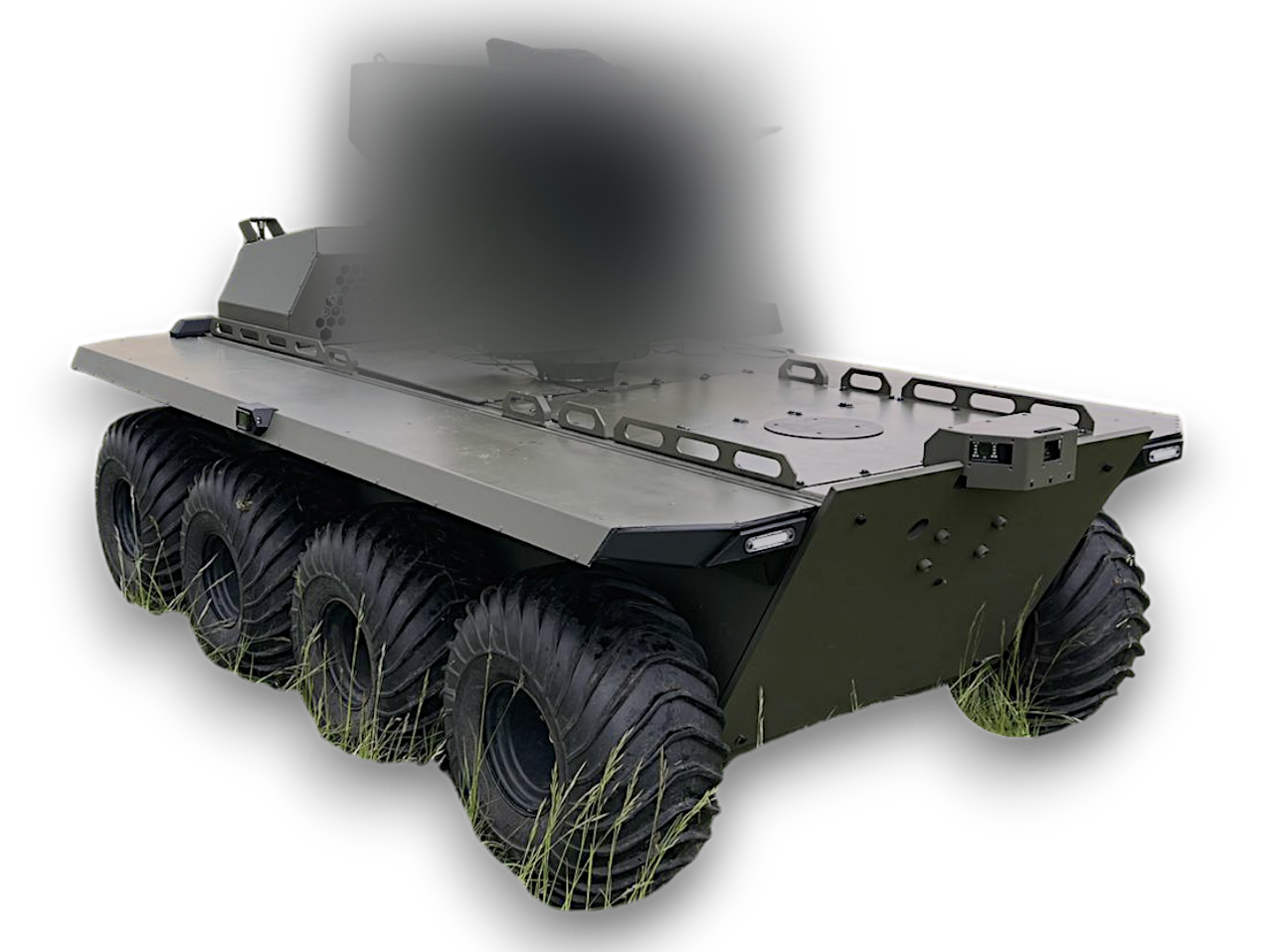
Spectre 8x8 · Uncrewed Ground Systems
Big Auto One builds the software that makes a ground vehicle uncrewed — remote driving, supervised autonomy, an independent safety core and redundant ground control. It runs on the Spectre 8x8. One crew, one mesh, as many vehicles as the mission needs.
What we build
The hull is somebody else's business, and a good one is already built. What decides whether an uncrewed vehicle is useful is the crew's ability to command it from somewhere else — through terrain, weather, distance and interference. We build that, at both ends and across the network between them, so the behavior at the edge of contact is designed rather than discovered.
Spectre is an 8x8 built by Jackson Duma Defense Group, the platform manufacturer we work with. It has been tested by multiple governments and entities, and it is ready for manufacturing today. We do not make hulls. We make everything that turns one into a vehicle a crew can send somewhere and trust to come back.
Capability
Six things the system is built to do. Each of them runs end to end today against the real vehicle software, the real safety core and the real ground software in the loop.
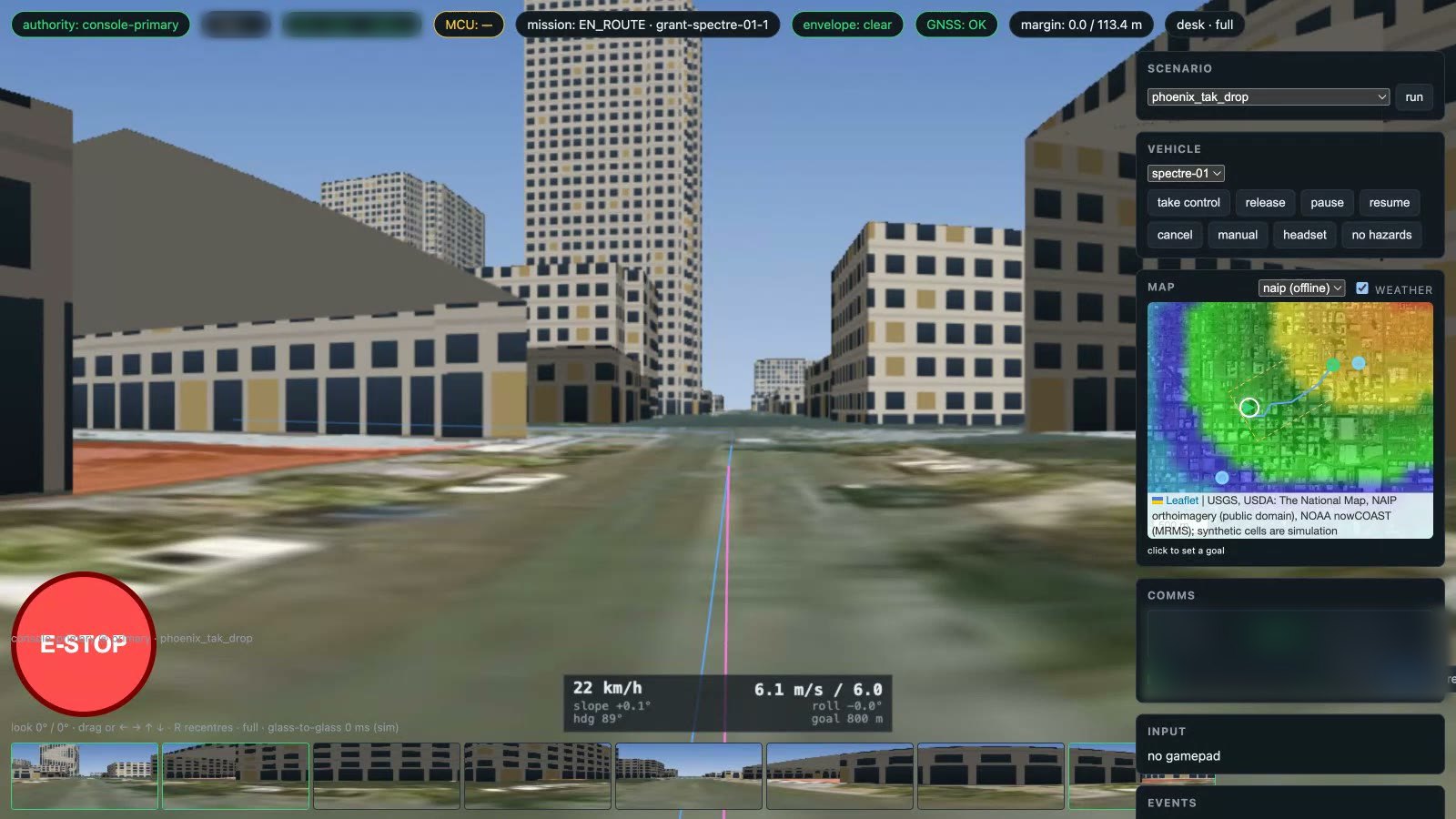
An operator drives with live video and a terrain picture built onboard. The vehicle enforces its own envelope while they do it: speed comes down for slope, surface and obstacles, and the vehicle stops rather than drive somewhere it has assessed as untraversable — whatever the stick is asking for.
Designate a goal on the map, set a corridor, a duration and the health limits you are willing to accept, and authorize it. The vehicle plans its route, drives it, and replans around whatever it meets. The authorization is the contract: pause, redirect or cancel at any time you are in contact.
Losing the link is a condition, not a fault. An authorized mission continues inside the geofence and the time limit the operator set, and the vehicle re-establishes contact and reports. Outside of an authorization, loss of link has one defined, enforced behavior, and it belongs to the safety core rather than to the software that was driving.
Vehicles are peers on the same network, each with its own mission and its own authorization. One crew can dispatch a group to a single objective with a separation between them, or work each vehicle independently. Adding a vehicle adds a node, not a new ground installation.
Lose a compute unit, a radio, a network switch, a sensor or a command center and the vehicle keeps control and keeps going, with less capability and a slower ceiling. Two independent failures bring it to a controlled stop. The degradation is a designed ladder, not an accident of what happened to still be running.
Geofence, speed ceiling, stop-on-loss-of-link and the arbitration between control sources are enforced on the safety core, independently of the software that plans routes. A planning fault is contained by something that does not plan.
Flexibility
The stack is written against interfaces, not against parts. What a sensor is matters far less than what it is required to deliver, and that boundary is where the system is designed to be changed.
The autonomy asks for a terrain model and classified obstacles at a rate and a range. How that is produced — and by what — is a fitting decision, not an architectural one. Change the sensing and the planner does not change with it.
Mission equipment rides on documented power, data and command interfaces, and the vehicle will measure and report what it is actually carrying. A payload change is a configuration item with limits attached, not a software program.
Every radio is a peer and no link is privileged. The gateway will carry a session across whatever paths exist — mesh, relay, a long-haul backhaul — and tell the operator honestly what it has left.
The vehicle publishes into, and takes tasking from, the common operating picture a unit already uses. A hazard somebody else reported becomes a keep-out the route bends around, without an operator retyping anything.
The same software runs on the vehicle, on a bench with the hardware emulated, and entirely in simulation. Standard robotics middleware where an integrator wants it, and a lean path where they do not.
Every threshold that shapes behavior is a versioned, signed configuration value rather than a number buried in logic. Re-roling a vehicle is a reviewed change to a file with a signature on it.
Where it works
The missions below are not brochure scenarios. Each one is a rehearsal we run on real terrain data, with the real software, because the ground decides the route and we would rather find that out before the day.
Load, route and resupply over ground a crewed vehicle should not be exposed on, with the crew somewhere else.
A static or roving vehicle holding a picture of ground it can see, cross-checked against what another vehicle believes.
Flooded streets, burnt canyon roads, a route nobody can plan in advance because the map is out of date by hours.
Built ground, moving people and vehicles, and positioning that cannot lean on satellites between the buildings.
Talk to us
The useful conversation starts with the ground you need covered, the picture you already run, and what has to keep working when the link goes. We will tell you what that means for the vehicle.